

A CONVERSATION WITH DR. LIZ NOBIS, MENTAL HEALTH PROFESSIONAL FOR THE PORTLAND THORNS
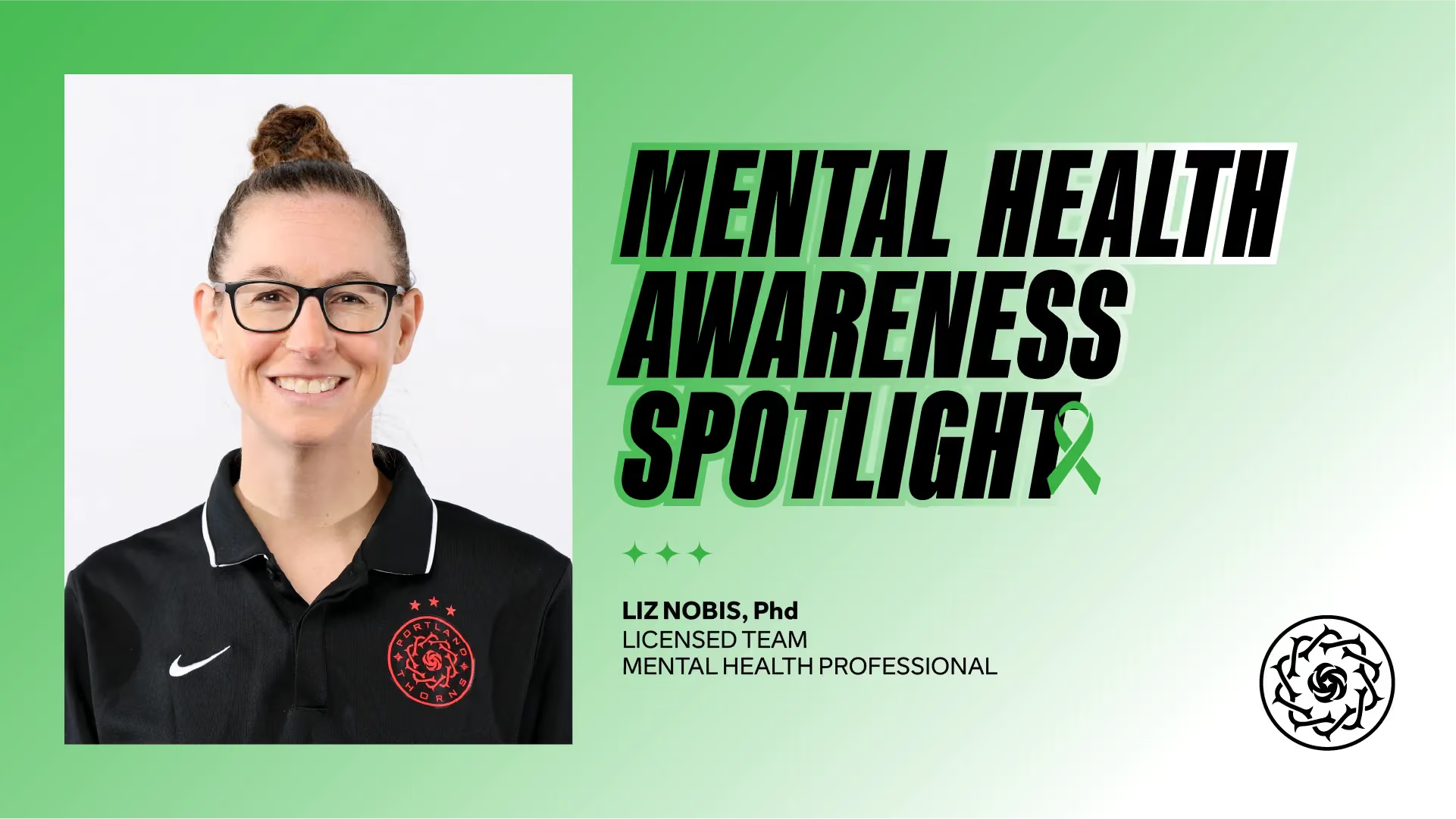
As the Portland Thorns continue to observe Mental Health Awareness Month, the Club took time to sit down with Dr. Liz Nobis, a licensed psychologist who has supported and guided players with the difficulties and pressures of being a professional athlete.
The life of a professional athlete extends far beyond what is visible on the field. Dr. Nobis supports athletes in managing the multi-layered demands of their careers, emphasizing a collaborative, athlete-led process that empowers individuals to define their own goals and take meaningful steps forward on their own terms.
Dr. Nobis has served as a mental health resource for Thorns players since 2025. and she took time to answer questions about the role that mental health has in professional sports, what it’s like working with athletes and what she hopes people take away as conversations around mental health continue to grow.
---
Q: How was it that you got your start working with athletes?
A: I got started working with athletes through a combination of a lifelong connection to sport and a professional path that led me into high-performance environments. I grew up playing soccer and basketball, and later running became a significant part of my adult life, so parts of the athlete experience was never abstract to me.
Alongside that personal connection, my psychology training and systems-level work in public health, brought me into Division I athletics at the University of Pennsylvania. There, I developed mental health and sport psychology infrastructure, provided clinical support, and collaborated across sports medicine, coaching, and performance staff. From that foundation, it’s been such an honor to continue that work with female professional athletes here at the Thorns.
Q: How big of a role does mental health play in the life of an athlete?
A: Our mental health and well-being touch every aspect of life, including performance, athlete identity, and our relationships. Athletes operate within demanding and dynamic environments, so I view mental health as a foundational element of success, both in sport and in life. Just as physical health is essential to athletic success, emotional and psychological well-being also require care and intentional attention, as they shape how athletes adapt to pressure, manage setbacks, sustain performance over time, and navigate the many demands of life both within and beyond sport.
Q: Working with athletes to help them navigate the challenges they face or encounter in their daily lives is no easy feat. How do they differ compared to other groups of people?
A: I consider it a privilege to walk alongside people and connect with them, especially in difficult moments. One thing that often stands out when working with athletes is how strongly they want to grow and improve. That drive is one of their strengths, though at times it can also create pressure or have unintended consequences when it becomes too intense. Part of my role is to understand how those patterns have developed, what is working or not working well, and where a different approach may better support them.
Q: Typically, what does the process look like for you when working with an athlete and how do both parties find the time to have those conversations?
A: One of the most important things to recognize is that this work is completely voluntary, whether an athlete chooses to use club, league, or outside resources. Athletes have autonomy in deciding what type of support feels most helpful to them. It is also important that these services be accessible and collaborative, including coordination with mental performance support when appropriate, so that athletes can receive care that fits their needs and circumstances. Because an athlete’s schedule with games and travel does not always allow for a traditional therapy model, it has been beneficial to shift from the traditional office and directly into their performance environment.
Q: How do you get to that phase where athletes begin to have difficult conversations with you?
A: Building toward difficult conversations often starts with consistency, availability, and trust. Athletes need to know there is space for them beyond moments of crisis or performance concerns. Confidentiality is also a critical part of that process. Athletes operate in highly visible, highly evaluated environments, so understanding that conversations are private and protected allows them to feel safer being honest about what they are experiencing.
Q: What’s it like knowing you can be someone an athlete can come to for support?
A: I feel very fortunate to be in a position where I can serve that role, and it is all in service of making sure players and staff feel supported. We all see the highlights, but life is not made up of highlights alone. Life includes both joy and suffering, and struggling or suffering alone can be deeply painful. Mental and emotional growth requires honesty, is supported by psychological safety, involves tolerating discomfort, and takes sustained effort over time; I’m grateful for the opportunity to support athletes through this process.
Q: As our society continues to have larger conversations around the importance of mental health, what is something you urge people to keep in mind?
A: Globally, it’s encouraging that we are making space to think about mental health in terms of being a whole person, not just in terms of performance or productivity. Therapy is a space where uncomfortable emotions and challenging experiences are not only validated but also explored with care. Growth is rarely comfortable—it often requires us to look honestly at our role in the dynamics we’re in and at what we bring to our relationships, careers, and choices.
Q: Do you have a personal message or any words of advice for people as we continue to honor and recognize Mental Health Awareness Month?
A: Just because a next step or change can be simple in concept, does not mean it's easy to execute. When supporting ourselves or others, it’s important to hold a balance of kindness and honesty, because we rarely know the full weight of what someone else is thinking or feeling. Our players deeply care for and regularly support their teammates, and that spirit of care can extend to how we relate to ourselves. A question worth asking is: how can we be our own best teammate?
PORTLAND, Ore. (Saturday, August 15, 2026) – The Portland Thorns continued their impressive home form with a 2-1 win over Orlando Pride on Saturday when forward Caiya Hanks — who was making her return to the pitch after missing action for over a year with an ACL injury — scored a stoppage time winner to secure three points for the home side.
Both sides battled back and forth as they tried to search for the opening goal, with Thorns goalkeeper Mackenzie Arnold making three saves to ensure the match remained level going into the halftime break.
The Thorns came out into the second half much more threatening in Orlando’s half and finally broke the deadlock in the 58th minute when forward Pietra Tordin laid the ball off to forward Deyna Castellanos, who from the top right corner of Orlando’s box placed the ball perfectly into the top left corner of the goal over the hands of Orlando goalkeeper Anna Moorhouse.
The lead was short lived however when Arnold’s diving save to punch out a crossed ball in the 63rd minute ricocheted off the knees of Orlando forward Jacqueline Ovalle and rolled into the net to level things back up.
From there, Portland and Orlando continued in their fight to search for a second and despite several good looks at goal, the match remained level.
That would all change after Hanks — who subbed on in the 88th minute — curled the ball into the goal from outside the box in the 96th to send Providence Park into a frenzy as the Thorns secured three points and extended its home unbeaten streak to 12 matches, nine on the season.
UP NEXT: The Portland Thorns host Denver Summit FC for the first time at Providence Park on Saturday, August 22. Kickoff is scheduled for 5:45 pm PT on ION and 910 ESPN Portland. Purchase tickets for the match HERE.
TEAM NOTES
GOAL BREAKDOWN
First Half
N/A
Second Half
POR – Deyna Castellanos (Pietra Tordin) 58’
ORL – Jacqueline Ovalle 63’
POR – Caiya Hanks (M.A. Vignola) 90+6’
LINEUPS
Portland Thorns (4-2-3-1): Mackenzie Arnold (GK), M.A. Vignola, Jayden Perry, Isabella Obaze (Sam Hiatt 78’), Carolyn Calzada, Jessie Fleming-C, Nina Nijstad (Cassandra Bogere 85’), Pietra Tordin (Caiya Hanks 88’), Deyna Castellanos (Renee Lyles 78’), Marie Müller (Morgan Weaver 67’), Sophia Wilson
Subs not used: Morgan Messner (GK), Reyna Reyes, Shae Harvey, Mallie McKenzie
Orlando Pride (4-4-2): Anna Moorhouse (GK), Hailie Mace (Gabi Nunes 90+8’), Rafaelle (Zoe Matthews 89’), Cori Dyke, Oihane Hernández (Zara Chavoshi 76’), Solai Washington, Ally Lemos, Haley McCutcheon-C, Julie Doyle (Summer Yates 65’), Jacqueline Ovalle, Barbra Banda (Angelina 65’)
Subs not used: Cara Martin (GK), Cossette Morche, Luana, Nicole Payne
MISCONDUCT SUMMARY
POR: N/A
ORL: Jacqueline Ovalle (Yellow) 40’, Julie Doyle (Yellow) 52’, Rafaelle (Yellow) 85’
MATCH STATS
POR | ORL
Goals: 2|1
Assists: 2|0
Possession: 51|49
Shots: 10|12
Shots on Target: 4|6
Saves: 5|2
Tackles: 16|16
Tackles Won: 9|11
Interceptions: 14|26
Fouls: 7|6
Offsides: 0|1
Corner Kicks: 0|6
ATTENDANCE: 19,106
Referee: Brad Jensen
Assistant Referee 1: Katarzyna Wasiak
Assistant Referee 2: Sarah Gaddes
4th Official: Justin St. Pierre
VAR: Danielle Chesky
Assistant VAR: Seun Yinka-Kehinde
A CONVERSATION WITH DR. LIZ NOBIS, MENTAL HEALTH PROFESSIONAL FOR THE PORTLAND THORNS
As the Portland Thorns continue to observe Mental Health Awareness Month, the Club took time to sit down with Dr. Liz Nobis, a licensed psychologist who has supported and guided players with the difficulties and pressures of being a professional athlete.
The life of a professional athlete extends far beyond what is visible on the field. Dr. Nobis supports athletes in managing the multi-layered demands of their careers, emphasizing a collaborative, athlete-led process that empowers individuals to define their own goals and take meaningful steps forward on their own terms.
Dr. Nobis has served as a mental health resource for Thorns players since 2025. and she took time to answer questions about the role that mental health has in professional sports, what it’s like working with athletes and what she hopes people take away as conversations around mental health continue to grow.
---
Q: How was it that you got your start working with athletes?
A: I got started working with athletes through a combination of a lifelong connection to sport and a professional path that led me into high-performance environments. I grew up playing soccer and basketball, and later running became a significant part of my adult life, so parts of the athlete experience was never abstract to me.
Alongside that personal connection, my psychology training and systems-level work in public health, brought me into Division I athletics at the University of Pennsylvania. There, I developed mental health and sport psychology infrastructure, provided clinical support, and collaborated across sports medicine, coaching, and performance staff. From that foundation, it’s been such an honor to continue that work with female professional athletes here at the Thorns.
Q: How big of a role does mental health play in the life of an athlete?
A: Our mental health and well-being touch every aspect of life, including performance, athlete identity, and our relationships. Athletes operate within demanding and dynamic environments, so I view mental health as a foundational element of success, both in sport and in life. Just as physical health is essential to athletic success, emotional and psychological well-being also require care and intentional attention, as they shape how athletes adapt to pressure, manage setbacks, sustain performance over time, and navigate the many demands of life both within and beyond sport.
Q: Working with athletes to help them navigate the challenges they face or encounter in their daily lives is no easy feat. How do they differ compared to other groups of people?
A: I consider it a privilege to walk alongside people and connect with them, especially in difficult moments. One thing that often stands out when working with athletes is how strongly they want to grow and improve. That drive is one of their strengths, though at times it can also create pressure or have unintended consequences when it becomes too intense. Part of my role is to understand how those patterns have developed, what is working or not working well, and where a different approach may better support them.
Q: Typically, what does the process look like for you when working with an athlete and how do both parties find the time to have those conversations?
A: One of the most important things to recognize is that this work is completely voluntary, whether an athlete chooses to use club, league, or outside resources. Athletes have autonomy in deciding what type of support feels most helpful to them. It is also important that these services be accessible and collaborative, including coordination with mental performance support when appropriate, so that athletes can receive care that fits their needs and circumstances. Because an athlete’s schedule with games and travel does not always allow for a traditional therapy model, it has been beneficial to shift from the traditional office and directly into their performance environment.
Q: How do you get to that phase where athletes begin to have difficult conversations with you?
A: Building toward difficult conversations often starts with consistency, availability, and trust. Athletes need to know there is space for them beyond moments of crisis or performance concerns. Confidentiality is also a critical part of that process. Athletes operate in highly visible, highly evaluated environments, so understanding that conversations are private and protected allows them to feel safer being honest about what they are experiencing.
Q: What’s it like knowing you can be someone an athlete can come to for support?
A: I feel very fortunate to be in a position where I can serve that role, and it is all in service of making sure players and staff feel supported. We all see the highlights, but life is not made up of highlights alone. Life includes both joy and suffering, and struggling or suffering alone can be deeply painful. Mental and emotional growth requires honesty, is supported by psychological safety, involves tolerating discomfort, and takes sustained effort over time; I’m grateful for the opportunity to support athletes through this process.
Q: As our society continues to have larger conversations around the importance of mental health, what is something you urge people to keep in mind?
A: Globally, it’s encouraging that we are making space to think about mental health in terms of being a whole person, not just in terms of performance or productivity. Therapy is a space where uncomfortable emotions and challenging experiences are not only validated but also explored with care. Growth is rarely comfortable—it often requires us to look honestly at our role in the dynamics we’re in and at what we bring to our relationships, careers, and choices.
Q: Do you have a personal message or any words of advice for people as we continue to honor and recognize Mental Health Awareness Month?
A: Just because a next step or change can be simple in concept, does not mean it's easy to execute. When supporting ourselves or others, it’s important to hold a balance of kindness and honesty, because we rarely know the full weight of what someone else is thinking or feeling. Our players deeply care for and regularly support their teammates, and that spirit of care can extend to how we relate to ourselves. A question worth asking is: how can we be our own best teammate?


.avif)


