

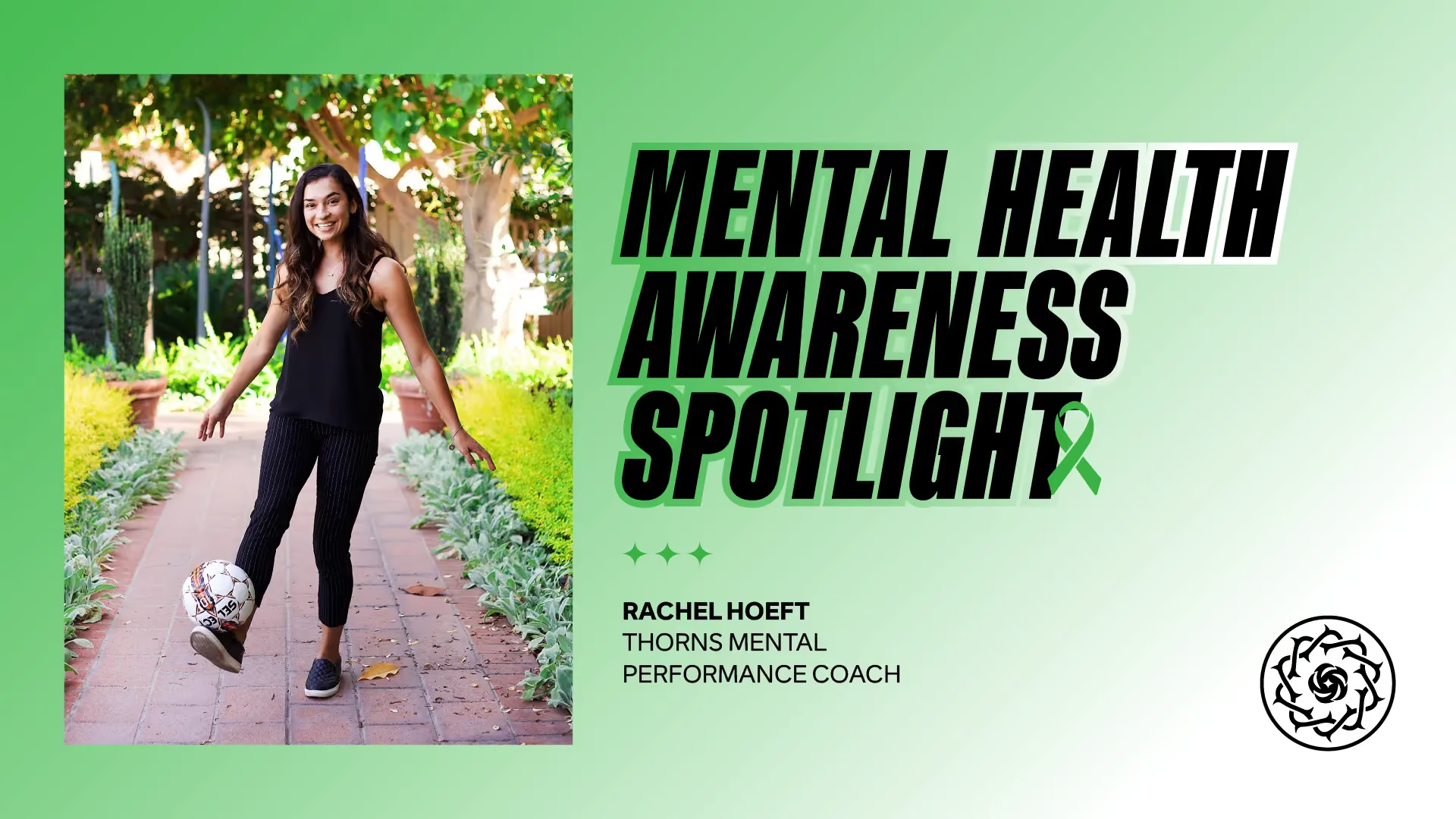
In observation of Mental Health Awareness Month, the Portland Thorns sat down with Dr. Rachel Hoeft, a Mental Performance Coach who has worked with the team over the last two seasons to help players overcome psychological obstacles and how to take better control of the emotions that come along with life’s everyday challenges.
From individual sessions to group activities, Dr. Hoeft has played a key role behind the scenes to strengthen the resilient mentality and infectious chemistry of the Portland Thorns squad on and off the pitch.
The conversation below provides a glimpse into how Dr. Hoeft got her start in the field, the lessons she’s learned along the way and the impact she has had not just with the athletes she works with, but in her own life as well.
---
Q: Could you explain how you landed on sport psychology and mental performance as a career?
A: I played soccer with dreams of playing in college but right before my senior year of high school, I tore my ACL. After going through the rehab process and being cleared by the doctor, I tore my other ACL the very next day. As I was trying to figure out how to navigate this process again, I really struggled because I didn't have the resources to know how to handle it either time.
Around the same time, my undergraduate advisor recommended I check out sport psychology and one of the first classes I signed up for was Psychology of Injury. I realized that this line of work was everything I needed but didn’t have as both a healthy and injured athlete and I wanted to be a resource for future athletes so they don’t struggle through similar experiences like I did.
Q: Mentally, how difficult is it to deal with injuries as an athlete and how does a mental performance coach tie into that process?
A: I had dreams of continuing to play after my injuries, and I believed in my abilities to do so, but my last surgeon told me I should give up the sport without even asking me my thoughts on the matter. That was hard to hear, and I have players that will talk to me about similar negative experiences with medical professionals.
As a mental performance coach, I can walk through the difficult reality of a situation with an athlete, talk through what makes the most sense for them, and help them make informed decisions for their future that they truly believe in. That process can be overlooked sometimes, but it is huge in making the athlete feel supported and empowered.
Q: Over the course of your athletic career, you suffered three ACL tears and one meniscus tear. How does personal injury experience create a sense of common ground with players?
A: When athletes are dealing with any sort of injury that puts them on the sidelines and they hear about my injury history, you see them realize that I understand, in a sense, what they are going through.
What’s often hard for people is not knowing how to be supportive because they can’t exactly put themselves in the shoes of the other person. In my experience, athletes often find themselves comforting the people who are trying to comfort them because those people just don’t know how to handle the situation. When I come along and tell them I personally understand what they are dealing with, it alleviates these uncomfortable feelings so they can just be there for themselves and not have to carry other people through the process.
Even if my situation is not the same as what the athlete is dealing with, they know somebody else understands them and that is valuable for players who need to work through vulnerable emotions and thoughts.
Q: Nowadays, greater emphasis is being placed on mental and emotional well-being. What are your thoughts on this growing focus?
A: I think it's been a long time coming. Many more people are investing the time and sharing the value of prioritizing personal well-being, so I see huge growth in athletes when they can understand where their thoughts and emotions are coming from and how to feel in control of those.
Many athletes are used to sweeping their challenges under the rug but the phrase I use with them is “If you sweep enough things under the rug, eventually you trip on it.” We see with so many people that when you do not address your mental challenges, it reaches a tipping point that can’t be reversed, and it can bleed into all areas of life. My goalis to teach athletes the tools before things feel unmanageable so that we can proactively contain and control rather than having to do cleanup work each time.
The more the athlete invests in themselves and understands who they are, the more emotionally and mentally stronger they become. They can better balance everything going on in their lives and are able to focus much more clearly on the challenges in front of them.
Q: How valuable is that growing emphasis on mental health to players and what effects have you noticed as a result?
A: After a few sessions, I can see huge changes in the way an athlete holds themselves, and the players start to influence their teammates as well. I’ve witnessed players with tendencies to be more negative become a different person after working on their positive self-talk and managing these thoughts to the point where they’re also curbing the negative self-talk of their teammates, so it begins to snowball and we actively create a more supportive environment across the board. Now it's not just one person trying to support everybody but rather the creation of a culture where everybody is supportive of each other on and off the field.
Q: How do you manage resistance to your mental performance support?
A: Resistance comes from people feeling forced. The thought process for some is “I got here on my own, why do I need to work on this?” and my response to that is telling them that everyone is working on the physical game, but not everybody is working on the mental game. If you’re not working on that, then the other person already has a leg up on you.
Ultimately, you must meet people where they're at. I am not here to force mental performance on anybody. I try to make it really clear for players that I am always here if they want or need the support but if they don’t want it, that’s okay. Pushing people into this does not work and that’s not the kind of person I want to be. My job is to be available and connect with them on a human level first. When they are ready to work on the mental piece, then I am here for that.
Q: How does the process typically begin? How does it work?
A: The athlete is the leader in this process. If it's important to them, then it's important to me. It can't be the other way around. Part of this process is me understanding what it is that they are working towards, what their goals are, and what their perceived obstacles are, then helping them learn the right tools so that they feel capable of navigating through that.
Mental strength and performance are dependent upon taking positive action no matter how difficult the situation in front of you is or how awful you might feel. This process can be difficult and requires a lot of intentional work, so at the beginning, I just want players to bring a little self-awareness to the situation. Can you recognize the moments that are unsupportive for your performance? Can you bring your attention to the moments where you're creating a perspective that's working against you instead of for you? Once we can identify those, we can do something about it but until athletes are able to accept that their perspectives are not working for them, I have to do some digging to shed the light on their biggest obstacles. That requires getting to know them on a personal level to where they can open up more about the way that they look at the world.
Q: Are there any things you’ve learned about yourself or applied to your own life when working with the players?
A: Every now and then, I have a session with an athlete where I watch them have this big “aha moment” and those are the moments for me where I know I'm in the right place, doing exactly what I’m meant to be doing.
That was the reason I got into this field in the first place. I wanted to be that support when athletes felt like they needed somebody else to guide them through a situation that was new or one that they're familiar with that's just really challenging. That encourages me to create more of these conversations and to be a person who will listen to them so they can learn more about themselves.
Q: What is the most gratifying thing about working as a mental performance coach?
A: I always tell athletes that mental strength and mental performance are about being able to make long-lasting changes in the way that you look at the world. Our thought processes are habits, which means we are typically looking at things the same way we do in all aspects of our life. I get so excited when I work with a player on something for soccer and they recognize they were handling similar situations with school or family the same way, and then they can use those very same skills for something outside of the sport.
That’s the goal of mental performance, for people to feel more capable of handling every challenge that comes their way on and off the pitch.
Q: How do you stay grounded?
A: Balance in this role requires you to purposefully refresh yourself mentally, physically, and emotionally all the time. I always tell athletes your additional activities should be something that gives you more energy when you’re done. For me, it’s any sort of exercise or reading. It is another way to keep myself engaged and afterwards, I feel accomplished and ready to take on the next challenge.
As someone who works in the mental health field, people bring in a lot of big emotions, and I need to be able to receive it. Being mentally, physically, and emotionally drained does not make you a good practitioner, so I repeatedly ask myself how I can make sure I’m always refreshed so that I’m showing up at 100% for the people depending on me.
Q: How do you look back on your impact in the field?
A: I’m trying to think of a word big enough. I have worked with athletes who become interested in the field of mental performance and sport psychology because of the improvements it has made in their lives.
It’s very full cycle for me getting to share information and being a part of somebody else’s success to where they want to share that success with others. That’s more than I could have asked for when I was 19 learning about this field for the first time.
Q: Do you have a personal message or any words of advice for people as we continue to honor and recognize Mental Health Awareness Month?
A: The work is hard, but I've never seen anybody regret it. The more you learn about yourself, the more you can achieve because you understand where you're strongest and where you can lean on other resources to get you through the hardest moments. Everybody is worth that investment in themselves.
PORTLAND, Ore. (Saturday, August 15, 2026) – The Portland Thorns continued their impressive home form with a 2-1 win over Orlando Pride on Saturday when forward Caiya Hanks — who was making her return to the pitch after missing action for over a year with an ACL injury — scored a stoppage time winner to secure three points for the home side.
Both sides battled back and forth as they tried to search for the opening goal, with Thorns goalkeeper Mackenzie Arnold making three saves to ensure the match remained level going into the halftime break.
The Thorns came out into the second half much more threatening in Orlando’s half and finally broke the deadlock in the 58th minute when forward Pietra Tordin laid the ball off to forward Deyna Castellanos, who from the top right corner of Orlando’s box placed the ball perfectly into the top left corner of the goal over the hands of Orlando goalkeeper Anna Moorhouse.
The lead was short lived however when Arnold’s diving save to punch out a crossed ball in the 63rd minute ricocheted off the knees of Orlando forward Jacqueline Ovalle and rolled into the net to level things back up.
From there, Portland and Orlando continued in their fight to search for a second and despite several good looks at goal, the match remained level.
That would all change after Hanks — who subbed on in the 88th minute — curled the ball into the goal from outside the box in the 96th to send Providence Park into a frenzy as the Thorns secured three points and extended its home unbeaten streak to 12 matches, nine on the season.
UP NEXT: The Portland Thorns host Denver Summit FC for the first time at Providence Park on Saturday, August 22. Kickoff is scheduled for 5:45 pm PT on ION and 910 ESPN Portland. Purchase tickets for the match HERE.
TEAM NOTES
GOAL BREAKDOWN
First Half
N/A
Second Half
POR – Deyna Castellanos (Pietra Tordin) 58’
ORL – Jacqueline Ovalle 63’
POR – Caiya Hanks (M.A. Vignola) 90+6’
LINEUPS
Portland Thorns (4-2-3-1): Mackenzie Arnold (GK), M.A. Vignola, Jayden Perry, Isabella Obaze (Sam Hiatt 78’), Carolyn Calzada, Jessie Fleming-C, Nina Nijstad (Cassandra Bogere 85’), Pietra Tordin (Caiya Hanks 88’), Deyna Castellanos (Renee Lyles 78’), Marie Müller (Morgan Weaver 67’), Sophia Wilson
Subs not used: Morgan Messner (GK), Reyna Reyes, Shae Harvey, Mallie McKenzie
Orlando Pride (4-4-2): Anna Moorhouse (GK), Hailie Mace (Gabi Nunes 90+8’), Rafaelle (Zoe Matthews 89’), Cori Dyke, Oihane Hernández (Zara Chavoshi 76’), Solai Washington, Ally Lemos, Haley McCutcheon-C, Julie Doyle (Summer Yates 65’), Jacqueline Ovalle, Barbra Banda (Angelina 65’)
Subs not used: Cara Martin (GK), Cossette Morche, Luana, Nicole Payne
MISCONDUCT SUMMARY
POR: N/A
ORL: Jacqueline Ovalle (Yellow) 40’, Julie Doyle (Yellow) 52’, Rafaelle (Yellow) 85’
MATCH STATS
POR | ORL
Goals: 2|1
Assists: 2|0
Possession: 51|49
Shots: 10|12
Shots on Target: 4|6
Saves: 5|2
Tackles: 16|16
Tackles Won: 9|11
Interceptions: 14|26
Fouls: 7|6
Offsides: 0|1
Corner Kicks: 0|6
ATTENDANCE: 19,106
Referee: Brad Jensen
Assistant Referee 1: Katarzyna Wasiak
Assistant Referee 2: Sarah Gaddes
4th Official: Justin St. Pierre
VAR: Danielle Chesky
Assistant VAR: Seun Yinka-Kehinde
In observation of Mental Health Awareness Month, the Portland Thorns sat down with Dr. Rachel Hoeft, a Mental Performance Coach who has worked with the team over the last two seasons to help players overcome psychological obstacles and how to take better control of the emotions that come along with life’s everyday challenges.
From individual sessions to group activities, Dr. Hoeft has played a key role behind the scenes to strengthen the resilient mentality and infectious chemistry of the Portland Thorns squad on and off the pitch.
The conversation below provides a glimpse into how Dr. Hoeft got her start in the field, the lessons she’s learned along the way and the impact she has had not just with the athletes she works with, but in her own life as well.
---
Q: Could you explain how you landed on sport psychology and mental performance as a career?
A: I played soccer with dreams of playing in college but right before my senior year of high school, I tore my ACL. After going through the rehab process and being cleared by the doctor, I tore my other ACL the very next day. As I was trying to figure out how to navigate this process again, I really struggled because I didn't have the resources to know how to handle it either time.
Around the same time, my undergraduate advisor recommended I check out sport psychology and one of the first classes I signed up for was Psychology of Injury. I realized that this line of work was everything I needed but didn’t have as both a healthy and injured athlete and I wanted to be a resource for future athletes so they don’t struggle through similar experiences like I did.
Q: Mentally, how difficult is it to deal with injuries as an athlete and how does a mental performance coach tie into that process?
A: I had dreams of continuing to play after my injuries, and I believed in my abilities to do so, but my last surgeon told me I should give up the sport without even asking me my thoughts on the matter. That was hard to hear, and I have players that will talk to me about similar negative experiences with medical professionals.
As a mental performance coach, I can walk through the difficult reality of a situation with an athlete, talk through what makes the most sense for them, and help them make informed decisions for their future that they truly believe in. That process can be overlooked sometimes, but it is huge in making the athlete feel supported and empowered.
Q: Over the course of your athletic career, you suffered three ACL tears and one meniscus tear. How does personal injury experience create a sense of common ground with players?
A: When athletes are dealing with any sort of injury that puts them on the sidelines and they hear about my injury history, you see them realize that I understand, in a sense, what they are going through.
What’s often hard for people is not knowing how to be supportive because they can’t exactly put themselves in the shoes of the other person. In my experience, athletes often find themselves comforting the people who are trying to comfort them because those people just don’t know how to handle the situation. When I come along and tell them I personally understand what they are dealing with, it alleviates these uncomfortable feelings so they can just be there for themselves and not have to carry other people through the process.
Even if my situation is not the same as what the athlete is dealing with, they know somebody else understands them and that is valuable for players who need to work through vulnerable emotions and thoughts.
Q: Nowadays, greater emphasis is being placed on mental and emotional well-being. What are your thoughts on this growing focus?
A: I think it's been a long time coming. Many more people are investing the time and sharing the value of prioritizing personal well-being, so I see huge growth in athletes when they can understand where their thoughts and emotions are coming from and how to feel in control of those.
Many athletes are used to sweeping their challenges under the rug but the phrase I use with them is “If you sweep enough things under the rug, eventually you trip on it.” We see with so many people that when you do not address your mental challenges, it reaches a tipping point that can’t be reversed, and it can bleed into all areas of life. My goalis to teach athletes the tools before things feel unmanageable so that we can proactively contain and control rather than having to do cleanup work each time.
The more the athlete invests in themselves and understands who they are, the more emotionally and mentally stronger they become. They can better balance everything going on in their lives and are able to focus much more clearly on the challenges in front of them.
Q: How valuable is that growing emphasis on mental health to players and what effects have you noticed as a result?
A: After a few sessions, I can see huge changes in the way an athlete holds themselves, and the players start to influence their teammates as well. I’ve witnessed players with tendencies to be more negative become a different person after working on their positive self-talk and managing these thoughts to the point where they’re also curbing the negative self-talk of their teammates, so it begins to snowball and we actively create a more supportive environment across the board. Now it's not just one person trying to support everybody but rather the creation of a culture where everybody is supportive of each other on and off the field.
Q: How do you manage resistance to your mental performance support?
A: Resistance comes from people feeling forced. The thought process for some is “I got here on my own, why do I need to work on this?” and my response to that is telling them that everyone is working on the physical game, but not everybody is working on the mental game. If you’re not working on that, then the other person already has a leg up on you.
Ultimately, you must meet people where they're at. I am not here to force mental performance on anybody. I try to make it really clear for players that I am always here if they want or need the support but if they don’t want it, that’s okay. Pushing people into this does not work and that’s not the kind of person I want to be. My job is to be available and connect with them on a human level first. When they are ready to work on the mental piece, then I am here for that.
Q: How does the process typically begin? How does it work?
A: The athlete is the leader in this process. If it's important to them, then it's important to me. It can't be the other way around. Part of this process is me understanding what it is that they are working towards, what their goals are, and what their perceived obstacles are, then helping them learn the right tools so that they feel capable of navigating through that.
Mental strength and performance are dependent upon taking positive action no matter how difficult the situation in front of you is or how awful you might feel. This process can be difficult and requires a lot of intentional work, so at the beginning, I just want players to bring a little self-awareness to the situation. Can you recognize the moments that are unsupportive for your performance? Can you bring your attention to the moments where you're creating a perspective that's working against you instead of for you? Once we can identify those, we can do something about it but until athletes are able to accept that their perspectives are not working for them, I have to do some digging to shed the light on their biggest obstacles. That requires getting to know them on a personal level to where they can open up more about the way that they look at the world.
Q: Are there any things you’ve learned about yourself or applied to your own life when working with the players?
A: Every now and then, I have a session with an athlete where I watch them have this big “aha moment” and those are the moments for me where I know I'm in the right place, doing exactly what I’m meant to be doing.
That was the reason I got into this field in the first place. I wanted to be that support when athletes felt like they needed somebody else to guide them through a situation that was new or one that they're familiar with that's just really challenging. That encourages me to create more of these conversations and to be a person who will listen to them so they can learn more about themselves.
Q: What is the most gratifying thing about working as a mental performance coach?
A: I always tell athletes that mental strength and mental performance are about being able to make long-lasting changes in the way that you look at the world. Our thought processes are habits, which means we are typically looking at things the same way we do in all aspects of our life. I get so excited when I work with a player on something for soccer and they recognize they were handling similar situations with school or family the same way, and then they can use those very same skills for something outside of the sport.
That’s the goal of mental performance, for people to feel more capable of handling every challenge that comes their way on and off the pitch.
Q: How do you stay grounded?
A: Balance in this role requires you to purposefully refresh yourself mentally, physically, and emotionally all the time. I always tell athletes your additional activities should be something that gives you more energy when you’re done. For me, it’s any sort of exercise or reading. It is another way to keep myself engaged and afterwards, I feel accomplished and ready to take on the next challenge.
As someone who works in the mental health field, people bring in a lot of big emotions, and I need to be able to receive it. Being mentally, physically, and emotionally drained does not make you a good practitioner, so I repeatedly ask myself how I can make sure I’m always refreshed so that I’m showing up at 100% for the people depending on me.
Q: How do you look back on your impact in the field?
A: I’m trying to think of a word big enough. I have worked with athletes who become interested in the field of mental performance and sport psychology because of the improvements it has made in their lives.
It’s very full cycle for me getting to share information and being a part of somebody else’s success to where they want to share that success with others. That’s more than I could have asked for when I was 19 learning about this field for the first time.
Q: Do you have a personal message or any words of advice for people as we continue to honor and recognize Mental Health Awareness Month?
A: The work is hard, but I've never seen anybody regret it. The more you learn about yourself, the more you can achieve because you understand where you're strongest and where you can lean on other resources to get you through the hardest moments. Everybody is worth that investment in themselves.


.avif)


